Your Focus and The Crooked Path
For Where Your Treasure Is, There Your Heart Will Be Also - Matthew 6:21
I have not talked about my own experiences for a while. If you have read the first three chapters you might think that the author... In other words, yours truly... Had it all together and all figured out. That is so far from the case. The fact that I had no clue at so many points in my life was what caused so many of my problems. What I have been describing so far in this book is what I have learned to be true. It is learned experience. I am so far ahead now of where I was even just a few years ago, and still have so far to go. I am becoming.
I have described how I felt a calling on my life. I felt this for the first time in my adolescence

or teenage years. And I felt the nudges many times as the years progressed and I followed my path. One of the problems I had was that I didn’t know what to do with that calling. Especially when I was younger. I didn’t know what my calling was, other than that I would be different as an adult. I would treat my children and my wife differently than how I was treated. I could do better. I would do better. But I didn’t define how that would happen and what it would look like, and even what the whole thing meant. Essentially, I would put that calling in a box and put it up on a shelf, and then life would go on. I filed it away. I knew it was there, but it was out of sight.
But if I wanted to experience that better life for me and my future family, my calling had to be front and center in the forefront of my mind. I couldn’t ignore it. Because there was work to be done. I could not achieve it the way things were in my life at the time. It was not as simple as flicking a switch and putting a smile on my face. By placing that calling, or that desire or what you want in your life, in a box... Filing it away or putting it up and a shelf... You forget about it. And when you forget about it you get distracted. You neglect the inner work that needs to be done and the growth that needs to take place. And then we wonder why things don’t turn out the way that we would like and why we get off track and never get to that place that we would like to be.
It is not as though we feel broken, although that can happen, as it did to me further along my path. We simply feel stuck. Things are not working the way that they should, or the way that we wanted, hoped for, or dreamed. The effort may be there, but the progress is not. And that is how life can get. Life can get clogged up. Like a drain. Nothing is happening and things are backing up. We are trying to move forward, but something is blocking the flow. Old mindsets, old habits, old fears, old stories and distractions.
And when that happens it is time to clear out the blockage. Not just partially. Not a quick fix. It is not a matter of pouring a little liquid plumber down the drain. You need a real plumber to clear it out. To check the pipes. Dig down deep and get to the root of what is really causing the blockage in you living the life that you truly want and desire. And then, how do you prevent your life from getting clogged up again? It all comes back to knowing what matters most in your life. Determining your True North. Deciding what the vision is that you have for your life.
No One Runs A Race Well Without Knowing Where They are Headed
Fix your eyes on the vision that you have for your life and that will help you get to where you would like to be. That is what vision does. Vision clears what is stuck. It gives motion direction. It tells you what is worth dropping and what is worth keeping. It provides you with direction toward your True North. It provides direction toward a life that is truly worth living. You need to reevaluate the things in your life that are not adding to it and focus on or add those things that get you moving in the right direction. It is about focusing on those things that bring your vision to life. A vision that is worth giving your life to.
The truth is that most of us don’t make bad decisions because we are bad people... We

don’t get off track or stuck because we are stupid... We make bad decisions because we don’t know what we are aiming for. We get off track because we have no idea where the target is. And that is why we overspend. That is why we settle in relationships. And that is why we give our time away to things that don’t give much back in return. We get tripped up so easily.
And if I had to summarize why I encountered issues along my path, I would say that it all started with exactly that. I did not have my eyes on my target. I didn’t know what I was aiming for and I had no idea where the target was. I didn’t have my eyes on my prize. And the prize is not a thing. It is a feeling. My problem, and so many people's problems, is that they attach themselves to things and not a feeling. Not a cause. Not a vision of something that is truly fulfilling. Vision hits differently. It is that special ingredient that sends that recipe over the edge. It is that special dish that keeps you coming back. It is the reason that you get up in the morning energized, come rain or come shine. Real vision stirs something in your heart. It makes you want to be part of something that is bigger than yourself.
Vision gives pain purpose. It turns sacrifice into an investment. It is about moving towards something meaningful and worthwhile and ultimately leaving a legacy long after we are gone. Not so much in what we did, but in how we lived, and the lives we touched and the difference that we made along the way. It is how we will be remembered. Our vision (where we are going) affects our mission (how we live). And the sooner you determine your vision and your mission, the sooner you can start living the life that is truly meant for you.
How Do You Determine Your Mission and Your Vision?
You will find there are so many approaches that you can take, but for me the starting point was sitting down and seriously determining what mattered most to me and then putting into the form of a personal mission statement. In Back On The Crooked Path, I discussed the idea of writing a mission statement for yourself. keeping it front and center, and the related benefits to doing just that.
Start by examining your Aura of Dominant Thought. That area in our minds that contains all

the things that we dwell on that dominate our thoughts. I stated in Back On The Crooked Path that there are many things that can contribute to our dominant thoughts. Things such as our health, our relationships, our finances, our family, our career, our plans for the day, deadlines and events, and all of the interactions and issues that we are dealing with. We could be dwelling on past events, worrying about the future, or ruminating on news, world events, politics, social issues, or the economy.
We can then sort through all of those thoughts and create something called our Aura of

Impact, which contains those things within our Aura of Dominant Thought that we actually have control, or some control, over. Leaving everything that we cannot control in an area called our Aura of Irrelevance. Our basic mindset flows from how we see, and what exists in each of these auras.
How we spend our time and see the world goes a long way in determining what our values are. It also reflects how we see our lives. Our vision for our lives, or lack thereof. It is in our Aura of Dominant Thought where we can truly reflect on how we see the world and where we spend our time to see if it all truly reflects what we state are our values. Is our light shining or is it dimming? What are we focusing on that causes us to dim? What can we focus on to cause us to shine? What changes can we make in what we focus on and how we spend our time so that we can move forward positively? What can we stop dwelling on in our Aura of Dominant Thought that is not helping us to live authentically?
Wherever your focus is in your Aura of Dominant Thought, will be your source of Safety,

Direction, Judgment, and Strength. These elements are tied and even directly correlated to your thoughts. Let’s deal with these one at a time...
Safety - Your dominant thoughts don’t always create external safety, but they determine your sense of internal safety. In other words, your inner security. Thoughts that are dominated in fear will make you feel unsafe, even in stable conditions. But thoughts grounded in trust and faith can help you feel secure, even in the midst of uncertainty. Your experience is driven by your dominant thoughts. Your feeling of safety will also drive who you are, how you feel about yourself, your groundedness, and your capacities.
Direction – Your dominant thoughts act like an internal compass. What you repeatedly think about becomes what you see, and what you see influences the choices you make. Your thoughts interpret everything that is happening around you and act as guideposts in determining not only your choices, but also your actions, and responses to what is happening around you. If your thoughts are aligned with values and purpose, direction and alignment are the result. If they are scattered, then confusion and misalignment follows.
Judgment – Good judgment grows from reflection, perspective, self-awareness, and an integrated experience. Poor judgment often comes from emotionally reactive thinking. Judgment is related to your perspective towards life. Things like balance, critical thinking, emotional intelligence, and an understanding of cause and effect. Your dominant thoughts condition your judgment.
Strength – Your dominant thoughts affect your perceived strength. Your beliefs affect your courage and your ability to act. They affect your resilience and your ability to follow though, especially in the face of adversity. Your dominant thoughts can also undermine your strength.
Your sense of safety, direction, judgment, and strength all work together. They all affect each other. Weakness in one area can weaken the others, and stability in any of these areas can act as an anchor that can facilitate growth in any of the other areas. True safety and clear direction can result in good judgment. When you know who you are and where you are going, then it is much easier to make aligned decisions. And as you do that, you get stronger. Stronger in facing your fears, stepping into discomfort, and moving forward.
These four factors are so important. They affect every area of your life. The degree to which you have developed each of them will go a long way in determining where you are on your path. If all four of them are underdeveloped or weak, you are likely very dependent. Attached to other people and things. Those things in your Aura of Irrelevance. If you are strong in all four areas, you are focused on your Aura of Impact. Focusing on those things that are within your control. You have the foundation necessary to take aligned action on your path.
Think of the difference between feeling unsafe or insecure on your path and feeling certain in who you are and what you stand for. Think of the difference between having no direction and relying on others compared to being certain in where you are going. Think of the difference between having skewed judgment where nothing aligns, compared to a sense of balance in how you see things. Looking at the lessons versus the obstacles and considering all variables that go into why things might be the way they are. And finally, the difference between feeling unempowered and even paralyzed. Being the object of someone else’s agenda and whims compared to taking the wheel and being your own driving force in your life. Being the flow and not going with the flow.
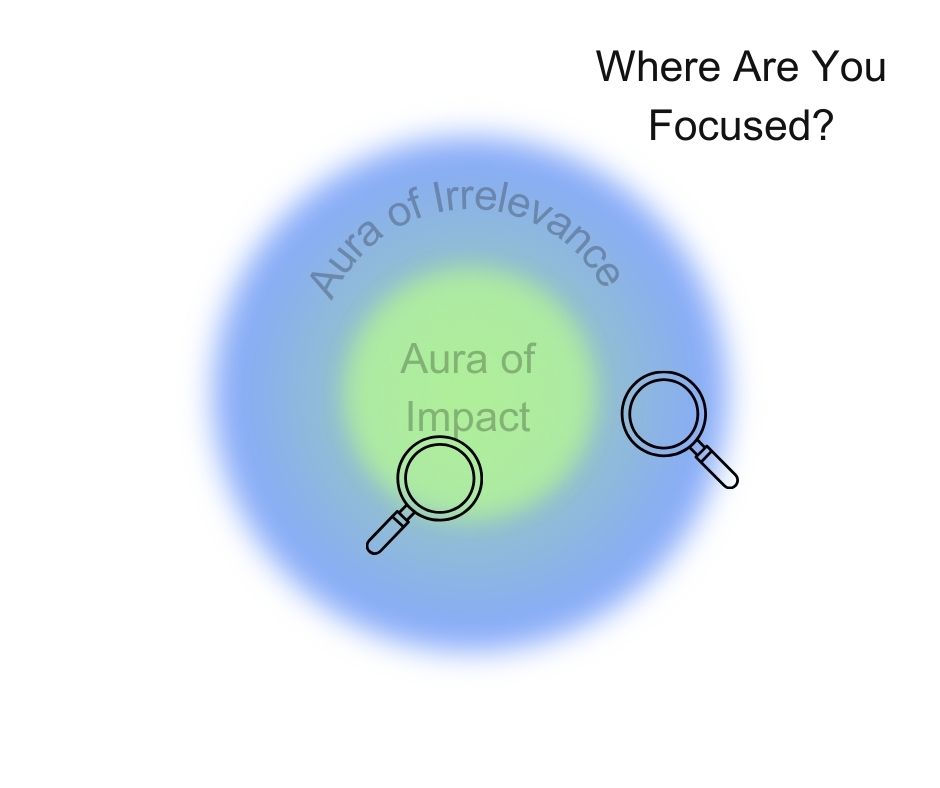
Your safety, direction, judgment, and strength all affect your focus, and direct it to areas within your Aura of Impact or Aura of Irrelevance. And where your focus is, matters. It affects every area of your life and contributes to either a positive or negative impact.
What Is Your Focus?
We all have a focus in our lives. Many don’t acknowledge it or think of it in that way. And that being the case, we don’t realize how our focus affects everything in our lives. Let’s look at some of those things we may be focused on.
Partner / Spouse Focus – Choosing your spouse or life partner is one of the most important decisions that you will ever make. You are not just choosing a partner. You are choosing a long-term lesson in empathy, patience, and emotional maturity. You are choosing the emotional support that you will receive throughout your life. You are choosing your future. This relationship will shape how you see yourself, and have a profound impact on your energy, health, self-perception, and potential. People often enter into a marriage or long-term relationship thinking that once they are together, then all of their problems are going to go away. That their marriage is going to solve everything. But that could not be further from the truth. A marriage or partnership only shines a light on all of the issues. It puts a magnifying glass on them. Marriage doesn’t take all of your troubles away. Often, it amplifies them.
Of course, marriages are meant to be satisfying, fulfilling, and uplifting. And many of them are. But let's get real... Anywhere from forty to fifty percent of marriages end in divorce. And ask yourself what percent of the remaining sixty percent are hanging by a thread, or have settled into codependent or transactional relationships.
If your primary focus is partner or spouse focused, you will have a strong emotional dependence on them. If your sense of safety comes from that relationship, then those feelings of safety are heavily based on the way your partner treats you. We are vulnerable to their feelings and their moods. There is conflict when expectations aren’t met or when you see things differently, and this can lead to arguments or withdrawal.
Your direction is greatly affected by what your partner might think or prefer. Your judgement is affected by how a decision might affect your relationship. And your strength is weakened by the codependence between you and your partner. You may not be able to make the most basic of decisions without running it by them.
Family Focus – You may wonder what is wrong with being focused on your family. After all, family is the basic building block of society and the basic building block of our lives. You would thing that focusing on your family should be normal and the right thing to do. But a family focus can be deceiving.
Obviously, there are some real, valid, and important strengths in having a family focus. but the problem comes when you outsource your internal compass to that of your family. When your family becomes the main source of what is right or wrong. It can stunt identity and individuality. Especially for children, as they grow and develop their own understanding of themselves and the world around them. Your identity requires answering questions such as... What do I believe? What do I value? What kind of life am I called to live? Even if your family doesn’t agree with you or carry the same beliefs or values.
If family becomes the overriding factor in making decisions, you may avoid the right choices for you. Choices that may divert you from your family’s norms. You may suppress yourself, simply to maintain harmony and not rock the boat. You may confuse loyalty with alignment. In other words... My family, wrong or right.
And this isn’t rebellion against the family. It is self-abandonment disguised as responsibility. Conflicts can feel destabilizing. Distance feels threatening. Disapproval feels like danger. A family focus can limit your judgment and perspective. All families can have blind spots, unexamined beliefs, and emotional loyalties that distort objectivity. Growth requires stepping outside of the system in order to see it clearly.
Strength drawn from family often works well when things are going well. But when there are strained or broken relationships... Illness or loss... or when expectations clash with reality, then people can feel unhinged, betrayed, or destabilized in ways that they never experienced before. Not because they are weak, but because their strength wasn’t fully internalized.
Money Focus – Who doesn’t want to make money? Money fuels everything else in our lives, right? The more money, the more freedom. One’s economic well-being is the basis for so many of the things in our lives that we want to do and have. The lack of money can cause and contribute to so many of our problems. It is a basic need.
Without money we can’t keep a roof over our heads, put food on the table, or clothes on our backs. We do without the basics or become dependent on outside assistance. We need money to care for ourselves and to care for our family.
The Love of Money
The Bible is often misquoted as saying that money is the root of all evil. What it actually says is that the love of money is the root of all kinds of evil. The desire for wealth can lead people to fall into temptation, traps, and harmful desires that lead to temptation. The love of money can cause people to stray from their faith, their values, and bring sorrow upon themselves. It is how money can control you, or your attitude toward money that causes the problem. Money itself is neutral, but in making it your primary focus, you end up anchoring yourself to something that is external and unstable. And that creates a quiet, yet powerful form of dependence.
Money provides a fragile safety. Markets shift. Jobs disappear. Your ability to earn an income can fluctuate. Economies can be unstable. If money is your main source of safety, your anxiety can increase if and when your income fluctuates. Fear of not having money drives your decisions. You stay in situations that don’t align because your income makes them “safe.” Safety rooted in money is conditional. The moment it is threatened, so is your peace.
Money is a tool and not a compass. When it becomes your primary focus, you end up chasing what pays, and not what aligns. Short-term gain overrides long-term purpose. You measure progress in dollars instead of meaning. This is how people end up successful on paper, but disconnected, burnt out, or wondering how they got so far off their path.
As far as judgment goes, money is a poor moral authority. It becomes the lens through which decisions are made. The question, “Is it right?” becomes “Is it profitable?” Values sacrifice themselves to the mighty dollar. Justification replaces discernment. Over time, judgment shaped by money erodes integrity. Usually not dramatically, but in small, repeated concessions.
Money can create influence, but it doesn’t create inner strength. When your strength is tied to your financial capacity, your confidence rises and falls with your bank balance. Setbacks in your finances feel like personal failures. Your identity becomes entangled in your net worth. True strength shows up when money can’t fix the problem. In situations such as loss, conflict, fear, and purpose.
Perhaps the greatest risk is that money slowly takes a place that it was never meant to occupy. It becomes a substitute for trust, meaning, and identity. It becomes a false anchor. One that promises certainty, but often cannot deliver it. Money works best as a servant and not a source. When it becomes the source, it competes with conscience, calling, and character. And often it will win.
Career Focus – Focusing on your career, work, or job can provide structure and meaning, especially if these things are missing in other areas of your life. But it comes with some real risks.
Work can feel stable, especially if things are unstable at home. You may feel affirmed, welcomed, appreciated, and valued. But any safety that you feel at work is ultimately unstable. Jobs change. Personnel and management changes. Companies restructure. Company direction changes. Markets shift and the economy changes. All these things can pose a threat to you. Demotions, surplus positions, and layoffs occur. There is office politics, and the whole thing can seem like a game of musical chairs where cooperation and collaboration are replaced with competition. Things may feel like they are safe, but things can change in an instant, and that shifting is not stable or something you can rely on. If you get your identity from your career, when things shift, you are vulnerable.
Your career can tell you what is next professionally, but not necessarily what is right for you. You can quickly become a workaholic. Producing at the expense of your health, your marriage, and your family. Deadlines, expectations, and even opportunities can conflict with deeper questions such as “Is this aligned with who I am?” or “Do I even like what I am doing?” You stay doing what you are doing simply because it pays the bills. Not because it is aligned with your calling or your values.
When work becomes your primary source of judgement... things like rest, relationships, and inner alignment take a back seat to everything on your To-Do List at work. Productivity, efficiency, and even optics become the main focus, rather than integrity. You may justify unhealthy patterns because you feel you are needed... Only you can do the job... And the task at hand becomes a worthy cause, making up for a lack of meaning in other areas of your life. What is effective at work starts to replace what is wise and what is right.
Work can be a powerful place to express competence, but it is the wrong place to source your identity. If your strength comes from being needed, capable or successful, then you will feel weak or defeated if you are not. Failure and criticism attack your sense of worth. And over time this can lead to burnout, resentment, and a lack of satisfaction in what you are doing. Retirement or job loss can trigger a crisis. If your sense of identity comes from your job or role in your career, once that is gone, you don’t know who you are. You feel lost when you are no longer defined by your work.
A career focus can mask a fragile inner foundation. It can crowd out your inner compass. It isn’t about not caring about your work. We all want to do something that is worthwhile. The problem is when you ask your career to provide you with something that it cannot sustain. Especially in the long run. Your income fuels everything else in your life, but you can become enslaved by what was meant to serve you.
Things Focus – We all want things in our lives. Let’s face it, we need things in our lives. Things provide real benefits. But so many people are driven to acquire things. Material things, but also things such as fame, status, or recognition.
But most things are fragile and offer little safety. Things can be lost, stolen, damaged, devalued, and taken away. They can be made irrelevant and obsolete. When you lean on things too hard, they break. Any strength or peace that you find in things or possessions is conditional. You feel secure, as long as you have these things. And the thing about things, is that they don’t satisfy. You always want the next thing, another thing, or more things. Your things end up owning you.
When things guide your direction, life will subtly shift from where your soul is calling you to go, to where things are calling you to go. Decisions become based on accumulation and not alignment. Opportunities are determined by payoffs and not meaning. You hold onto things that you are meant to let go of. Growth requires you to let go of things that no longer serve you. Things end up holding you back. Your path narrows. You stop moving towards purpose. You settle and seek out comfort.
Things distort your judgment. Things don’t have wisdom. How you evaluate everything... People, situations, and even yourself... Is seen through the lens of your (or their) things. You judge success by appearance rather than character. Self-worth becomes tied to the things that you own or possess, or to status or lifestyle. People are valued or dismissed based on what their material possessions are. Judgment becomes external based on things, and not internally grounded based on values.
And strength becomes conditional on your things. You get your strength from your things. When you lose your possessions or they are threatened, your strength diminishes. You live in denial and avoid necessary steps and action because of the risk of losing your things. True strength is forged internally through true values and character, and not through an inventory of your things. Your identity shifts from who you are to what you have. Comparison is unavoidable. You are always wanting more. you begin living in scarcity, even while surrounded by abundance.
Self Focus – In other words, being self-centered. Not to be confused with self-reliance. Self on its own has no value because it was never meant to be the sole source. People who are focused on self, take but don’t give. They accept but never extend themselves. When self is the primary reference point, what feels right to self replaces truth, wisdom, and moral grounding. Judgment is easily influenced by emotions, bias, and convenience. There is ignorance to blind spots. And over time this leads to justifying one’s actions, rather than self-awareness.
If safety and strength come from self, then a bad day can be traumatic. Failure becomes an identity crisis. Criticism becomes threatening, rather than a source of feedback. Strength is fragile and not resilient.
Self-centeredness is not independence. It leads to resistance to anyone else’s direction or counsel, difficulty in receiving correction or coaching, and shallow connections. The self has limited experience, incomplete information, and biases based on past successes, failures, and wounds. When direction and judgement come from self, you don’t challenge your behavior or thoughts, and growth is inhibited because feedback and information that doesn’t align is filtered out.
When self is the source of strength, you carry the weight of every decision. You generate meaning on your own. And you have the need to be right. You can’t sustainably be your own foundation. Self focus asks... What do I want? What benefits me? What feels good to me? Without the view of something larger than oneself, sacrifice feels foolish. Service is optional, and the idea of feeling responsibility to someone else feels too restrictive.
There is a healthy self and a central self. A healthy self is aware, responsible, reflective and grounded. A central self becomes the sun that everyone one else orbits around. The danger isn’t knowing yourself. The danger is centering everything on yourself.
There are many other common focuses that people can have that become the lens through which they see life, and through which they draw their safety, direction, judgment and strength. They could be focused on pleasure, fun or recreation. Their favorite sport or their favorite team. People can be focused on their faith, religion, or church. Many people are focused on politics and their political views. We focus on our friends.
Having an interest, a passion, a hobby, or an opinion isn’t the problem. So many of these things are just part of who we are. Part of our character, identity, and how we express ourselves. The problem occurs when the focus is not only dominant but is also rigid and inflexible. Something that blinds you to the opinions and needs of others. That leaves you closed off to influence. That causes you to lose any compassion or empathy. Something that can turn into an obsession or an addiction. Anything that blinds you to your own role as to why things are the way they are in your life. Why you are off track... Why you have relationship issues... Why you are triggered... Why you are stuck.
Your Focus Can Become a Problem In the Following Ways -
It Is Not Just a Source Anymore. It Is The Source - If you can’t function without it, you are no longer drawing from it... You are depending on it. A problematic focus crowds everything else out.
If It Defines Your Worth - If everything is going well, you are okay. But if there is loss, disagreement, or someone criticizes you, you are not okay. You feel threatened. Anything that controls your sense of worth ends up controlling you.
When It Overrides Reality – This shows itself when you openly defend it, when it is clearly harming you. When you ignore the results you are getting, feedback you are receiving, and other related consequences. This is when your judgment clearly becomes distorted by what you are focusing on.
When It’s Loss Would Collapse You – A great question to ask yourself is “If this was taken away... Or if this belief was proven to be untrue... Would I still know who I am and how to move forward?”
When It Becomes Entrenched In Your Identity – When your focus is not just the way you see the world. It is your world. When it becomes who you are, focus is no longer just the means. it is the end. Life will change, and identities that are too tightly entrenched do not adapt well.
When It Promises What It Cannot Deliver – Your focus gives a quiet promise of safety, direction, judgment, and strength. But when it inevitably fails... Whether you realize it or not... Whether you take responsibility for it or not... The fallout and the consequences are bigger than they needed to be.
The wrong focus becomes a problem when it shifts from something that is a part of your life to something that anchors your life. It is much easier to discern what someone else’s focus is compared to our own. Looking at someone else, we feel we are objective. We can base our conclusions on our own observations and our experiences with that person. We can see the results in their lives and rewind the tape back to the likely source of those results.
When it comes to ourselves, often we are blind. We are unaware. We are in denial. We don’t own our paths or take responsibility for the results we are getting in our lives. We justify and rationalize our actions, not wanting to face reality, step into discomfort, and forge a better path forward.
Where is your focus? Often, we are not consciously choosing where we focus, or what we focus on. We are just living from it. We evolve subtly into a space that feels safe. It feels right. It feels like this is a place where we can anchor, plant a flag, and take a stand. We don’t question it. And we build and we act from there.
For the most part, most people have multiple focuses and our focus can change throughout our lives. Let’s face it... We all have relationships... Family, friends, peers, and coworkers. We have interests. We have opinions. We have needs. Who we are can be a function of so many things in our lives.
To get an idea of what your focus might be, look at where your mind goes when you are under pressure. Pressure is revealing. When you feel anxious, threatened, or uncertain, what or who do you instinctively reach for? What you reach for in these moments often is your true source of safety, whether you realize it or not. We usually expose our focus when things are unstable.
What, if taken away, would make you quickly feel lost or powerless? What criticism of you would cut the deepest? Strong emotional reactions often will point to where your focus is. If something can easily rattle you, it likely holds more authority in your inner world than you realize.
Think about your decision-making process. When you are unsure, whose voice do you trust the most? How do you justify your decisions? It just feels right? This is what they expect? This is what is best for my family? This is what makes the most sense financially? This reveals who or what gets the final say.
What do you defend most fiercely? Anything that you get defensive about is a clue. What do you feel compelled to explain, protect, or justify? We feel the need to defend what our identity or security is tied to. If we feel like we are being attacked, the basis for the attack is likely foundational to our focus.
What gives you energy and what drains you? True sources of strength tend to stabilize us over time. False centers provide a temporary boost, followed by increased dependence and exhaustion.
Honestly ask yourself, what is it that I cannot be okay without. Whatever that answer may be... Whether it be a person, a role, a belief, a thing, or an outcome... It is at least competing to be your focus. And if something feels misaligned, that is feedback. It often means that what you are focusing on cannot carry the weight of safety, direction, judgment, and strength in your life.
What we need to do is bring our focus into focus. To be clearly focused on what gives us true safety, direction, judgment, and strength. A focus that is aligned, consistent, and congruent no matter where we are, who we are with, how we might be feeling, what we might be facing, what we might be doing, or what our situation might be.
And that is your next task, on The Crooked Path
Try This Exercise -
AfterNotes - https://www.youtube.com/watch?v=7rZyI7kPZMI Stand By Me - Ben E. King


Comments