The Ripple Effect of The Crooked Path
Updated: Jul 12
Faith Forward
There is a shape and progression to our spiritual growth. Everyone’s path is different. Some paths are wide, while others are narrow. Some have an expansive view, while others are limited. Some are progressive, while others are traditional. Some are free, while others are controlling. Some lift up, while others hold back. Some are on display, and others are hidden. Some are open and inclusive, while others are closed and exclusive. Some are alive, and others, quite frankly, are on life support. And if we took a snapshot of where we all were on the continuum of faith, we would all be at different places. Many have dug in and are rooted, while others continue to grow and explore, and others are not sure.
Spiritual growth is a continuum, and it looks something like this. There is movement from Inheriting to Adopting, then Questioning, Rejecting, and finally, Rebuilding. Inheriting the spiritual beliefs handed to you by your parents, whatever they may be. Adopting these beliefs as your own as you mature, and as these beliefs handed to you begin to be understood and integrated. Questioning those beliefs as you learn to think critically and maybe have experiences or adopt worldviews that contradict what you have been led to believe. Rejecting the beliefs that were passed to you and that you have held for various reasons, such as not being able to reconcile those beliefs with your life experience and what you have learned. And finally, Rebuilding. What do you actually believe? What is driving you? What do you stand for?
The transition from inheriting spiritual or religious beliefs to adopting them can be subtle
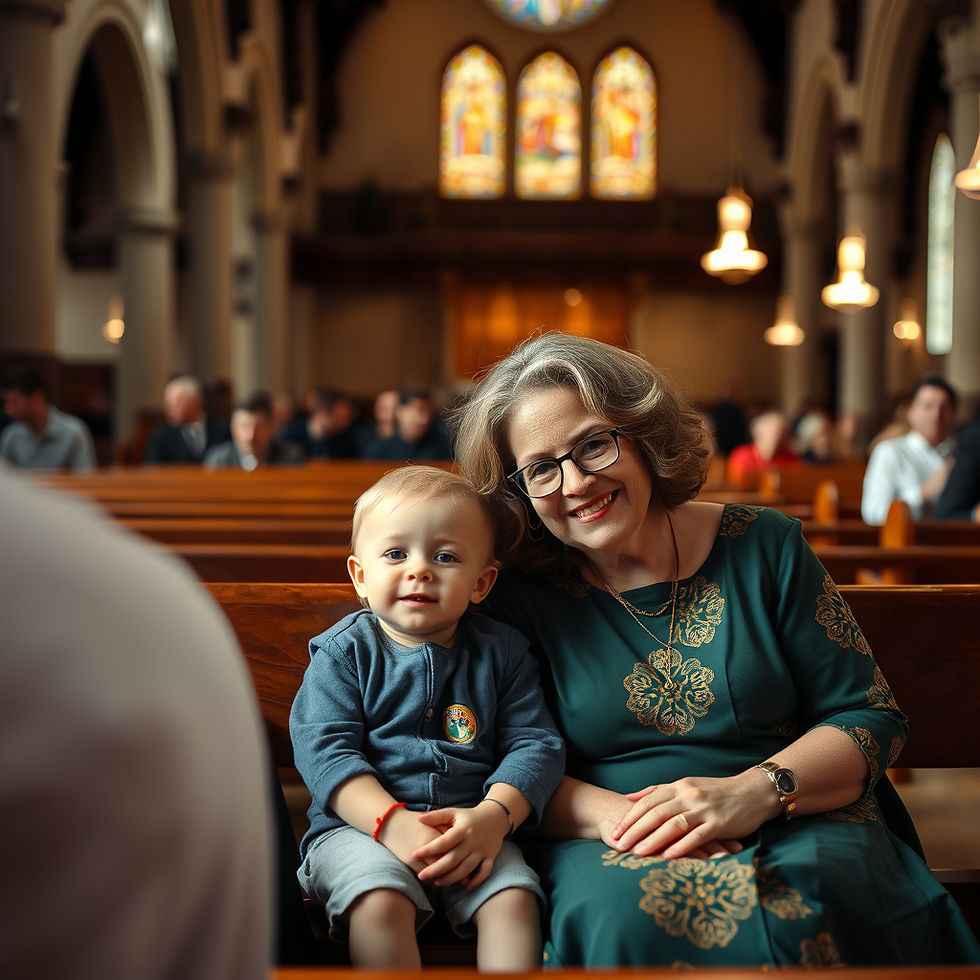
and gradual. A child usually begins by absorbing beliefs long before they are capable of consciously choosing them. At first, the beliefs are tied less to conviction and more to attachment, trust, identity, safety, and belonging.
In their early years, 'a child's spirituality is often experienced as... This is what my family does... These are our people... This is what is true because the adults that I trust say that it is... If I belong to them, then I belong to this. The beliefs are inherited more than examined. The child is borrowing a worldview from their parents.
We all are part of a generational story. Even the smallest actions

of those that went before us have a ripple effect on our paths. Ripple effects don’t always start with strategies or master plans. They start when something moves. They start through someone’s actions. Still water doesn’t ripple. Water starts to ripple when you drop a pebble in it. Change happens because someone decides to drop the pebble. When someone decides to move. Still water doesn’t ripple, and neither does a still faith. Faith doesn’t grow when it remains stagnant. Faith doesn’t get passed on if it remains dormant. You need to take the step. You need to drop the pebble.
The faith I have today started with the ripple effect of my mother’s faith, and hers would have started as a result of the effect of those who went before her. I often wonder where I would be today if my mother hadn’t stepped up. If she had not dropped the pebble. To appreciate where we are today and where we are going, we need to remember the steps that came first. Steps that weren’t even ours. To look at not only where we came from but also look at the steps and actions of those who shaped us.
We rarely are able to get to where we would like to be on our own. But so often we try. In this day and age, we have been programmed almost entirely as individuals. That is what the world and society tells us. That you can just do it on your own. You don’t need help and you don’t need others. We have become positioned and programmed to say that we can do this on our own. We can figure it out all on our own. That we know. But that is not reality. We are social creatures. We are wired for connection. The reality is that it is not just me. It is us. And so it goes with faith. Faith is about connection.
Our lives are more connected than we would like to admit. The good that we do ripples outward. The hidden stuff that we hope no one will ever find ripples outward as well. And this means that there really is no such thing as isolated faith. We stumble together. We grow together. We carry one another. We can also hold each other back.
The beauty and the mystery of communities, like our families, is that our lives become intertwined. Think of it this way... When one heart grows cold, other people feel it. When one person’s faith wavers It lowers the temperature in the room. If your parents or grandparents had faith, and then they lowered the temperature of that faith, what happens to you as a child or grandchild? You see that, and you lower your temperature. Thinking, if faith doesn’t work for them, then it is just not going to work for me. Compare that to the family that says that there is a God or Source who is faithful. He is faithful in life’s highs and in the lows. The view is that God is faithful when He didn’t answer my prayer or my life didn’t go the way I would have liked. God is faithful and we still believe in Him and trust Him, despite everything. And as a child or a grandchild, you saw that parent or grandparent, and you think... If God can work for them, then why can’t God work for me? This is key to how faith gets passed on from Inheritance (Stage 1) to Adoption (Stage 2). Not through coercion and fantasy, but through love and lived experience. Our faith either elevates the temperature in the room, or it dampens it. It heats the room up, or it cools it down.

Inheriting My Faith - Just to elaborate a bit more on my own spiritual journey. As a child, I would go to Sunday School because my mother would go to church on Sunday, and the expectation was that I would go to Sunday School. Many of my friends, classmates, and neighbors would be there. I would recognize a lot of faces. Going to church is what I understood people did on Sunday mornings. I believed in God because my mother believed in God. That is what she taught me. And if you believe in God, you go to church on Sunday morning. That was my inherited belief.
As a child, we borrow the worldview of our parents. But eventually something shifts. This can happen in adolescence. As the child matures psychologically and emotionally, they begin to separate themselves from their parents. They can ask themselves whether they actually believe this that was handed to them. And then they can ask themselves, what do I really believe?
For me it was not so much questioning my belief. I did not question the existence of God. But I did start to question why I had to go to Sunday school. Can’t I just acknowledge that He exists and leave it at that? Acknowledging that there was a God. but not knowing what that meant. Not really knowing what faith meant. Having one foot in and one foot out. At our church very few kids would attend Sunday school as they approached adolescence. Only the children from the most faithful families in the congregation would continue to attend. It was almost as if it was not cool to go to Sunday school once you got to a certain age. And ass I got older, I would not be forced to go. Sunday mornings would get filled with other things, such as swimming lessons for me or hockey practices for my brothers.
But my days of walking through the doors of the church were not over. On occasion, my mother would ask me to attend the actual church service with her. Maybe she saw this as a way for her to have some company on a Sunday morning and at the same time maintain my connection with the church. Mom would ask me, but not my brothers. It was not that my two brothers were not welcome to join us. My brothers were busy doing other things. I was five years older than my youngest brother. He was still of Sunday School age. My older brother was just on a different path and was, for the most part, not interested.
I usually would say yes when Mom asked. It was a chance for me to be with her. Attending the actual church service to me was kind of like graduating from Sunday school. It was like a move up from the cheap seats. I was with the adults now. Once at church, and seated in the pews, I would see a lot of people that I knew. People that I never noticed in church before. There were many people that my mother knew. There were neighbors, people that my mother knew through Dad’s hardware store, and people that we knew through the local community club. Many would bring their children, and I knew many of them. Some of them were classmates and there were others that attended my school. There were even some of my current and former teachers there. Seeing your teachers outside of a classroom setting to me was a little awkward. Realizing that they actually had a life outside of school.
Being a little shy or backward at the time, I felt more confident when I was with my mother. I would be more willing to engage in conversation with people, which usually was simply saying hello and responding politely to any of their questions. Mom was happy to be there, and that made me happy to be there with her. This was a period in my life where there was tension at home. Perhaps the tension was there all along, and I was just becoming more aware of it and how it was manifesting in different ways. As an adolescent, I was affected by it all. I was becoming more withdrawn and backward in many ways. Looking back, I can imagine how Mom must have been unhappy, stressed, or worried. I can see how going to church maybe gave her comfort. And maybe that was one of the reasons that I freely joined her. To be with her, and to seek some comfort of my own.
Faith Becomes Personally Meaningful Through Your Lived Experience
A big part of my initial experience was witnessing my mother’s faith. I was no longer being told to go to church. I was asked to go to church and would choose to go based on my own free will. I took the step from Sunday School to church because of my mother. She was the catalyst. If it was not for her, I would have stayed home. I credit my mother for keeping me on the early stages of my spiritual path. It was a time when I was growing up and trying to figure things out. Part of that growth would be the internalizing of values taught to me by Mom. It was a movement from my mother’s faith to the beginning of my own convictions. It would lead to a time where me attending church would not be dependent on her being there. I would go on my own because that is where I wanted to be.
No Siblings Have The Same Parents - Dr Gabor Mate
My brother’s paths... Their spiritual paths... were much different than mine. According to Gabor Mate, noted physician, author, and speaker... No siblings grow up in the same house. No siblings have the same parents. No siblings have the same family. And no siblings have the same childhood. Although similar, my brothers and I are very different, especially when it comes to our spirituality. Why is there such a difference between siblings? Dr. Mate’s view gave me some perspective. The first reason for the differences among siblings is birth order. Parents don’t relate to the first child in the same way that they relate to the second child, and then the third. It isn’t about loving one child more than the other. We love all our children. It is about what actually happens between the child and the parent. It is how each child experiences the parent. The child doesn’t experience the parent's love. The child experiences the parents in the way that they show up. Ideally parents lead with love when it comes to their children, but that is not always the case. Also, the parent’s relationship may be in a different phase with one child than with the others. The parents may be in a different economic situation. The parent’s lives might be different as each child comes into the world and goes through developmental phases. Each child may evoke a different response from a parent. It is not that you love any one of your children more than the other. But you respond to them differently. And finally, children are born with different temperaments. They experience the world differently. So, even if you could be the same parent to all of your kids, they would still have different parents because they would experience you differently. Parents show up differently for each child depending on the season of their life, their relationship, and even their financial situation. It’s not about who is loved more. It’s about how that love is expressed - and how each child experiences it. If you’ve ever wondered why you and your siblings remember childhood so differently - this is why. This realization received from Dr. Mate would help me make so much sense of our family dynamic as I look back on those years.
I would attend church with my mother, my brothers didn’t, and our spiritual paths would flow differently from that point on. I followed my mother’s lead. It is not so much that my brothers did not follow her, as they both inherited her moral values, but when it came to religion and Christianity their views have at least a degree of skepticism. My younger brother became a psychiatrist, and he married into a Catholic family. His wife is a devoted Catholic and practices her faith regularly. He agreed to and supported her desire to raise their children in the Catholic faith. His wife and children attend mass and go to church regularly. My brother does not. He is the one who prays occasionally, just in case. My older brother reminds me very much of my dad, although he was more certain in his views than Dad. His family would go to church occasionally. Mainly on Christmas, Easter, and special occasions, but rarely on Sunday. They had very busy schedules on the weekends, which would keep them away. But even though my brother had no issue with supporting the church financially, spiritually he had issues reconciling what he was hearing, seeing, and experiencing in church and with many of those who attended church, with his own views and experiences. I see both of my brothers as firmly Stage 3 in terms of their spiritual paths.
Unlike me, they rejected parts of what they inherited in their childhood, and they leaned toward independent thought with at least a degree of skepticism. And I will say that independent thought is a good thing. Questioning is part of genuine ownership and growth. A belief that survives examination usually becomes deeper and more authentic than one that is inherited. Inherited belief says, “I believe this because my parents (or this person, this group, this community...) taught me or told me to.” Adopted belief says, “I have wrestled with this... I have experienced life... And I have chosen this belief for myself.”
I would move from inherited faith to my own conviction that church is where I should be... at least occasionally. The belief that I had at the time was that the church had to be at least a part of my life. It had some role to play? But what exactly was that role?
What Causes Movement Along The Spiritual Path?
Think of all of the things that might move someone along their spiritual path. What moves them from one stage to another? Critical incidents? Suffering? Loss? Searching for answers? The need to belong? The need for community? Inspiration? The experience? Someone’s example? All of the above? An authentic spiritual path becomes personally real. My path would be no different.
Adopting My Faith - Once at a family gathering, I was asked what my least favorite part of the church service was by an older cousin.

She attended church with her family reluctantly, it seemed. To me, the answer was an easy one. There was no question that my least favorite part of the service was the sermon. And that is ironic because isn’t that the main point of going to church? To hear the message? To learn something? To be inspired? Clearly, I was missing something. She agreed with me. In her words, the sermon was boring.
So, why was I there? I wasn’t really big on community back in those days. I did not seek out social situations and preferred time by myself and not with crowds. I wasn’t great at talking to people I didn’t know. This was a time when the message, or the sermon, was a time for me to daydream. I would be one of the first ones to sneak out of the pews and then out the door at the end of the service. So much for community and fellowship. Sometimes I would shake the pastor’s hand, just so he had visual evidence that I was there. Still I was compelled to keep attending.
What did I like about attending church? What drew me there? One thing I liked was the music. There was something about the singing of the hymns that resonated. Sitting next to my mother, I would hear her singing, and that would encourage me to raise my voice as well. The best that I could anyway. We would hold the hymn book together. When I hear some of the traditional hymns today, it reminds me of my mother and sends a chill up my spine and often a tear to my eye. To this day, I have a preference for many of the traditional church music and hymns from back in the day rather than the newer songs of faith. As for the rest of the service, I pretty well had to languish through it.
But in time, the sermon would become less for naptime, and more for paying attention. The minister that I was used to since I was in Sunday School, with the booming voice and the fire and brimstone delivery (at least it felt that way) left and was replaced by a younger minister who was more relatable and had a softer delivery. I recall one of the first sermons I heard him deliver was a commentary on the musical “Jesus Christ Superstar.” That was a pivotal moment, not just for me, but for others in the congregation. One of my friend's dads would call the new minister “a hippie”. Times were changing. Over the years i would come to understand that one of the favorite scratching posts of the congregation in the church would be the minister or the pastor. Members either loved him, or they hated him. He was either the solution, or the problem.
My spirituality would also be influenced by my core group of friends. Their families attended the same church, and I would see them there. I would say my friends and I vibrated at a different frequency than many other kids our age. We had most of the same interests as other teenagers, but a different focus. The typical things that most teenage boys were into, such as sports, cars, dating, and rock and roll... Those things were not our focus. We were more introspective. Our conversations were deeper. Our conversations often were more focused on things like meaning, vision, ideas, growth, the future, and spirituality. I would say our interests were more abstract, and that would be reflected in the music that we listened to and the movies that we watched and the things that we did. We took our schooling and marks seriously. None of us were jocks. A few were members of the school drama club. We were more apt to go to the Manitoba Theatre Center to see MacBeth or Death of a Salesman, rather than some action thriller movie at the local cinema.
There were times when I would feel like I was on the periphery of our group. I have written

about how I had felt different in social situations back during those years, even with my closest friends. Feeling left out of conversations and not really having much to say. That had more to do with what was going on inside of my own head. Often, I was very distracted and unsure of myself. I remember feeling torn at times between our activities and what we would be doing and what our other friends or classmates would be doing. Ultimately, I would always find my way back to my core group, as they were who I truly resonated with.
I regard my friend, Jeff, as being the informal leader in my friend group. My best friend, Rob, and I regarded Jeff as slightly ahead of his time. Certainly ahead of our time. We saw Jeff as being truly self-actualized (referring to Maslow’s Hierarchy of Needs). For someone who was sixteen or seventeen, he seemed to have it all together and knew what he wanted. As it turned out, Jeff would influence me because of his spirituality. He attended church regularly. He was becoming active and participative in the life and work of the church. Much more than simply attending Sunday morning services. Jeff was a straight A student and class president in Grade 12. He was way more advanced than me in terms of how he thought and in what he was pursuing and accomplishing. There was no way that I could keep up with him, but being around him challenged my worldview and broadened my perspective.
Jeff would get confirmed within our church. In The United Church of Canada, confirmation is the public profession of faith where a baptized person (usually as an infant, but often as a youth or adult) affirms their baptismal vows, or the vows made on their behalf by the parents, and then takes ownership of their Christian journey. It signifies becoming a full member of the congregation and the wider United Church denomination, granting rights to vote in church matters and fully participating in its life and leadership.
That is taking your spirituality to the next level, when you are not just attending church, but you have confirmed your faith and your dedication to the life and work of the church. And that brings on a whole new level of roles and responsibilities.
In our church, confirmation was a public affirmation of faith. It is the point where someone personally confirms or claims for themselves the Christian faith and membership commitments that may originally have been made on their behalf at baptism. Prior to confirmation, there are typically a number of requirements, such as...
A period of classes or mentoring with the minister or church leaders
Learning about Christianity, the Bible, sacraments, prayer, ethics, and the church
Reflecting on personal beliefs and spiritual questions
Choosing whether they want to publicly affirm their faith
At the end of all of the prework, there is a confirmation service, where the person professes their faith publicly and becomes a full member of the church. In essence, what this all represents is a shift moving from an inherited belief to a personally examined belief, from childhood faith to an emerging adult faith, and from external authority to internal ownership. From Inheriting faith to Adopting faith
The fact that Jeff went through this process was not unnoticed by me. I would think about what it all meant. Is that something that I wanted? Is that something I would do? That question would fade for a year or so until the day my mother came home from church one Sunday with a notice that was in the church bulletin that advised of confirmation classes that were upcoming and looking for those who were interested in taking the step to be confirmed. Perhaps thinking it was time, she asked me if I was interested. She didn’t ask my brothers. I was the “chosen one.”
Saying yes to confirmation seemed like a natural step. After all, Jeff did it. It would make my mother happy. Logic seemed to point to it... Or did it? Would it solve all my problems? Would I all of a sudden become all-knowing? Does membership indeed have its privileges? Are these good reasons to get confirmed? Because a friend did? To make someone else happy? Because I think it is expected of me? To seek approval?
The question that I needed to answer and come to terms with was why I would take that step to get confirmed. But the broader question is how you move from an inherited faith to an adopted one? Decisions come with consequences. Decisions also come with responsibilities. This was a door that was presenting itself. It felt like an opportunity. It was a passageway. But a passageway to what? What lies on the other side? What would getting confirmed really mean and signify to me? I didn’t know. But I felt the pull. Ultimately, I felt it was something I was called to do and needed to do, even if I could not define the why.
You Will Know What To Do As You Take That Step
In my book, Back On The Crooked Path, I stated that “you will know what to do as you take that step. All of your experiences and lessons are shaping you and preparing you to level up. But you have to let go of the how, the when, and the why. Let go of the paralysis by analysis. Trust yourself and your intuition.” I believe that. Faith is forward movement. Faith is making a decision. Fear is no movement or even reverse movement. Getting confirmed seemed like the next step for me. But at nineteen years of age, I was not in touch with my intuition. As a result, so many things were not clear. They were muddy in so many ways, and I really was not in a good place in so many ways.
Decisions may not lead to a true transition or a leveling up at all if they are made for the wrong reasons. Such as family expecting it, friends doing it, fulfilling a tradition, or seeking approval. Internally a person may not feel very spiritual, not feeling a calling, not feeling a commitment, or not feeling a desire. Nothing may be resonating. They might simply be mirroring authority figures. Doing what is expected of them. They really have not examined their beliefs. They might even be questioning their beliefs. Really, they are not committed. And maybe they are just not ready.
The decision needs to be a conscious one. Made after personal reflection, wrestling with meaning, recognizing the responsibility, and also recognizing that it is your choice, where no one is forcing or coercing you. That is all part of healthy movement from Stage 1 to Stage 2. It also paves the way for future growth along your spiritual path.
Unhealthy decisions and wrong decisions are made more often than one might think. If
someone goes through a process like confirmation without the inner readiness, maturity, or genuine desire behind that decision, the process can become more performative than it is transformative. Outwardly they may “take the step,” but inwardly they may still be disconnected, confused, resistant, or not committed. And all of that is understandable... Especially for adolescents or teens, who are trying to figure everything else out. That would be me. And not being ready is okay, but no one told me that.
I finally did let go of the paralysis by analysis, the overthinking, the avoiding, and I made the decision to get confirmed... For mostly the wrong reasons. I was not ready. I was not able to do all of the pre-work or follow through after. There was just too much going on in my life. Too much confusion. Not knowing who I was. Identity issues. I wasn’t able to attend some of the meetings and classes leading up to confirmation. I let the group leader know and he said it was okay, and I could still move forward with confirmation, as long as that is what I wanted... So I went ahead with it. I was confirmed, fully unaware of what it meant and unprepared for what the responsibilities would be moving forward.
As human beings, we have the freedom to choose, and with those choices come responsibilities. Also, with our choices come consequences. We are free to choose, but we are not free to choose the consequences of our choices. There are natural consequences to all of the choices we make in life. We can also choose to avoid the responsibility of our choices, but that has consequences as well. You cannot avoid the consequences. Even if you try, they eventually chase you down.
I have no doubt that Jeff made his decision for the right reasons. He had done and was doing the inner work. He was involved with the life and work of the church and seemed to be quite certain of the path he was on. A few years later, he would switch gears in his path of study at university. Jeff paused his working towards a degree in Medicine, to study Theology for a year. And here I was, also confirmed but uncertain of the path I was on. Finishing off my first year in university that was stressful and disappointing, dealing with relationship issues, and not knowing what I wanted. I would start a part-time job that summer and my shifts would be on the weekend, which would prevent me from attending church services, let alone taking part in the life and work of the church. I would work that shift for the next four years as I finished off my degree and wouldn’t have an opportunity to attend a regular church service during that time.
My decision to get confirmed was probably premature. When you make decisions that you are not ready for, there are consequences. For me it was...
Obligation - I would start to get requests to join committees and take part in activities and take on responsibilities at the church. There were requests for financial support. There were expectations over and above attending church. Which led to...
Guilt – The feeling that came when I continually said no or politely declined or put off. Guilt that I wasn’t even attending church services. And then...
Disappointment – The feeling that I was letting people down. The feeling that I was letting myself down again. The feeling that I was letting God down. The reality that I was not fulfilling what I felt were my responsibilities as a church member. And finally...
Resentment - Questioning why I made the decision if I was not prepared for the responsibilities and the consequences. Almost regretting that I made the decision. Resenting the repeated requests from the church for my involvement.
Eventually the phone calls from the board and committee members of the church died down. A person can come knocking only so many times, and then they get the hint. I would remain a member but put whatever that meant in a box and up on a shelf as my life went on. Any growth in my spirituality at that stage was really performative and superficial. I had not internalized what it meant to take that step.
But in hindsight, the whole process was not a waste. I didn’t make the transition, but I would eventually. I was not ready at the time, but the whole process, as convoluted as it may have been, was meaningful to me. It watered a seed that had already been planted. I look back on that process as an invitation. Not just by my mother. Not by any member of the congregation of the church. But by God / Source / Creator / Higher Power. Faith is forward movement. The Bible states that "Faith without works is dead." I was being invited into something deeper. It was a nudge. I was feeling those nudges occasionally, but not realizing who or what it was. Now, I believe it was God. Who is infinitely patient. Even when we are slow to respond. Even when we resist. Even when we run. Even when we hide. Even when we push back. Even when we fall. Even when we get it wrong.
I wasn’t ready. I didn’t own enough of myself to be able to grasp what all of that meant and to understand that calling. I had so many other things I was dealing with. But the experience was not meaningless just because I was unprepared.
Real spiritual growth is not linear and in so many ways is not synchronized with religious milestones, such as confirmation. Spiritual development does not unfold according to a calendar. I learned that an unhealthy confirmation, or an unhealthy transition through any passage, is more about appearance or compliance. But a healthy process teaches that faith is an honest, personal, and evolving relationship with truth, responsibility, and with God. And that distinction became that much more relevant and meaningful to me as years progressed.
I look at this decision through the lens of the Triangle of Change -

Desire – During that period, I was searching. So many things were not right in my life. There was a gap, but I hadn’t defined what that gap was. Really, when you are feeling stuck, off course, or that things aren’t going right in your life, that simply means that you are misaligned in some way. You are not aligned with your true self. To get in alignment, you need to get to know your true self. Otherwise, every step you take gets you to the wrong place faster. I had desire. But the desire for what?
Motivation – Motivation being the drive or determination to act on your desire. Motivation is the fuel to act on desire. Really, motivation is the “why” that leads you to act. What is your big why? This leads back to the discussion of mission, purpose, and what matters most. What was my why? Why would I make the decision to get confirmed? I hadn’t defined my mission, purpose, or what mattered most to me, so any decision I made was based on external expectations and not my own. The motivation has to come from within in order to be sustainable. I did not know my "why."
Action – You act on the desire and motivation for change. Based on your action, you are now some place different than where you were. Things are different. Something has changed. But is this what you want? Is this what you expected? Is this where you want to be? The action needs to be intentional towards a desired change. If your action is not intentional, you may not get the desired change. And if you don’t know what it is that you want... If your desire is passive... If it has not been explored... If you are not sure... Then the odds are that your actions will be ineffective. Half-hearted and unsustainable. You will end up in a situation that you are not ready for or where you don’t want to be. And that is okay, but it leads you back to your desire and motivation and getting really clear on those things so that you can take aligned action next time. Failure to do that can lead to frustration, giving up, and settling. The triangle flattens, and you remain where you are. Misaligned.
When I look at this decision through the lens of the Triangle of Change, it can look like a failure. It can look like the wrong decision. But when I look at it through the lens of the Triangle of Purpose, I get a different perspective. The Triangle of Purpose is the process through which we can be drawn forward towards our purpose.
Look at my decision through the lens of the Triangle of Purpose -
Calling – Your calling doesn’t have to be defined. It can simply be a feeling... A feeling of

incongruence or unsettledness... But in reality it is more than that. It is more like an awakening that things don’t need to be this way. An activation. Something that gets your attention. Your soul awakening and nudging you. Opening you to possibilities. Opening you to not only the possibility, but to the reality that you were meant for more than what you are experiencing. There is something more for you, and it is calling you. It is more than a feeling of just being unsettled. I have described how I felt a calling in my own adolescent and teen years, but I had no idea what it was or what to do at the time. Call it a combination of hope and faith that things would be different, and I would know how it felt when I experienced it. Your calling is a seed that has been planted in you that is longing to grow. Your calling may fade from your mind, but it is still there. A seed ready to burst open. The next step is...
Signs – As you follow your path, you encounter signs, synchronicities, and what appear to be coincidences. But they are hardly coincidences. These may be people showing up in your path that point the way. Opening new doors and providing new opportunities. People, events, and feelings that resonate with you. Opportunities that are too good to be true. Many of these opportunities seem to come out of the blue and unexpectedly. And these things will resonate with you because of your calling. It is your soul speaking to you and leading you. What were some of the signs for me at the time? Who were these people? First of all, there was my mother. Watering seeds of faith in me since I was a child... Keeping me involved in church... And extending the invitation for me to consider confirmation. There was my friend group and the dynamics within that group that I had described, and especially the influence of Jeff. These and other people and events resonated and guided me to consider taking that step of faith. They pointed the way. Some would open doors. Without my mother’s example and influence, I never would have had that opportunity at that time. If I had another group of friends with different interests, church may have been the last thing on my mind. My head and interests likely would have been elsewhere. Finally, there is...
Action – Acting on any of the signs, synchronicities, or nudges. Taking a step of faith. Acting on that person’s advice... Stepping through that door that has just been opened. And aligned actions will lead back to your calling. And you get more clarity and certainty on what you are called to do. And the process continues. The signs get clearer. It is easier to recognize them because you know what aligns, what resonates, and what does not. You move forward with more certainty. As for me, I took that step and got confirmed, but I was not ready. That action was not aligned with where and who I was at the time. As a result, I experienced the consequences of obligation, guilt, disappointment, and resentment. But I don’t believe that I made the wrong decision. It was not a waste.
I felt the consequences of taking that step before being ready. They would weigh heavily on me, and I believe that was because I was going against my soul. I was being called to put my faith into action, and because I couldn't or didn't, I felt dissonance. If I truly made a performative decision, I wouldn’t have felt obligated. I would have the attitude of “It’s not my problem.” I wouldn’t have felt guilty or disappointed. The fact that I felt these things is evidence that the decision had meaning to me. Your soul is the best feedback mechanism. But your soul is also full of forgiveness, mercy, and grace. Just like the Creator who put that blueprint in you. Your misaligned steps and mistakes are lessons. And you will always have the chance to do better and to be better.
Sign, Sign, Everywhere a Sign - Five Man Electrical Band
A couple of years after the confirmation ceremony, and my last appearance at church, I happened to meet the minister of our church at a wedding that we were both at. I reintroduced myself, thinking that he may have forgotten me, and we had a great conversation. Fueled a little bit by alcohol, I must admit. I talked to him about that experience and that I felt badly about committing and not showing up or following through in any way. With the same grace and mercy of God, he said not to worry about it. He stated the obvious, that everyone is busy and assured me there will be other opportunities for me to become involved in whatever way I may choose in the future. I saw that random encounter and conversation as a sign. The minister coming across my path unexpectedly and giving me some affirmation that I really needed, and that would lighten my load in a small way at that time. Feeling some relief and putting off any future involvement to some far off date.
Faith is forward movement. Faith is not about appearances or compliance. Faith is an honest, personal, and evolving relationship with truth, responsibility, and with the source of truth... God / Source / Higher Power / Creator. Faith is aligned action. Faith without relationship with truth is exhausting. It results in climbing the wrong ladders and misaligned paths. Faith that is based on appearance or compliance is shallow. The gap between what faith is supposed to feel like and what it actually does feel like on a Monday morning is real. And that is not unusual. That is a very human story, and it did not start with me or you. It is a struggle that has been going on for centuries.
If faith is forward movement and aligned action along your spiritual path, I have come to

believe that the fuel or motivation for that faith is love. Faith is not merely a belief. It is movement, trust, and aligned action toward something meaningful and true. And love becomes the “why” behind the movement.
Without love, faith is merely obligation, fear-based compliance, following the rules, or adhering to doctrine or ideology. But when love is present, faith becomes relational and alive. It moves a person towards growth, sacrifice, courage, truth, responsibility, connection, and purpose.
Love is what gives faith direction. People move towards what they love. What someone truly loves determines where they invest their energy, what risks they might take, what suffering they may endure, and what path they follow.
Fear produces motion too... But usually defensive motion. Fear restricts, while love expands. Fear asks... How do I protect myself? Love asks... What is worth moving toward, building, protecting, serving, and becoming?
To refine that further, fueled faith forward comes from a healthy love of self. Not ego, arrogance, or being self-obsessed. But the recognition that your life has value and responsibility attached to it. Self-love becomes the belief that your life is worth living intentionally, caring for your time, talents, resources, and the world around you. It is the belief that your gifts matter, that you need to seek out and never abandon your soul, and that living out of alignment is a form of self-betrayal.
Someone who genuinely values themselves in a healthy way is more likely to pursue growth, leave destructive or toxic environments, speak the truth, set boundaries, take responsibility, take care of their health, seek and follow their purpose, and endure hardship in pursuit and in the service of something meaningful. The foundation of your path and spiritual growth is self-love.
Many people remain stuck because they do not have healthy self-love. They don’t believe that they are worthy or capable of the life that is calling them forward. Their faith collapses because their relationship with themselves is broken. Healthy love of self is believing that your life carries enough value and responsibility that you should not waste it by living out of alignment with who you were created to be.
So, how do we find self-love? By definition, self-love does not come from others. Others can love us, but that love is not always free-flowing or reliable or even felt. How can we love ourselves when we feel unlovable?
Love... Love... Love...
We are hard-wired for relationship. We are hard-wired for connection. That is how we were created. When we are feeling disconnected... When we are having relationship issues in our lives... When we are feeling all alone and unlovable... There is one connection that is always online, and whose love is unconditional and free-flowing with abundance... And that is God / Source / Creator / The Universe. God is a God of relationship, and when you connect to Him, something connects in you. You are not who other people say you are. You are who God says you are. And of all of the many things that God says about us, the one thing that stands out is that we are unconditionally loved. There is nothing that we have done, or nothing that we can do, that will separate us from that. Maybe that is the greatest task to realize along our spiritual path.
Come Near to God and He Will Come Near to You - James 4:8
It took me a long time to realize that and to feel that. But I believe that realization is what ultimately saved me when I was at my lowest, and it started me on the long road back. For the longest time, I felt that God was a God of judgment. A God that saw my mistakes and basically said, “It serves you right.” A God that I could never live up to. Just like I felt I couldn’t live up to other people’s expectations. But looking back, I see not only God’s unconditional love shown constantly in my life, but His forgiveness, mercy, and grace. You see, despite anything that you have done... The mistakes and the poor choices you have made... God knows what is in your heart. He put it there. Scripture says, “Seek and you will find...” God is a God of connection and He seeks relationship with you. He has already chosen you. You just need to choose Him. The Bible also says, “Come near to God and He will come near to you.” His calling on your life is absolute. It is irrevocable. He will continue to chase you down and work through you to the completion of your purpose. But you need to step forward with faith first. Seeking Him.
I would eventually move from Inheriting to Adopting the spiritual beliefs of my mother. They would become my own. Rather than planting that seed in me, it is more appropriate to say that Mom watered the seed that was already there. The seed for connection and relationship with God was already in me. The right conditions had to be there in order for it to grow. If Mom didn’t ask me at that time if I was interested in getting confirmed, I don’t know if and when it would have happened. As I said, life got busy for me right around that time. I wasn’t able to attend church for four years because of the shifts I worked on the weekend. And three years later Mom would get sick. A year after that she would pass away from cancer. Right when I was ready and available to attend church on Sunday morning again.
My mother’s passing was a significant passage in my life, for obvious reasons. We all had to pick up her torch. I believe the torch that she left for me to carry was the one of faith. I would be looked at as the person of faith in the family. Dad would ask me if I was going to church each Sunday. Not because he wanted to join me. I believe it was because he felt it was important to continue Mom’s legacy. So, I would return to church occasionally. I continued to pray before bed. I would be called. and looked at as “the religious one in the family.” And I felt that. It resonated. I felt honored to be regarded in that way, I suppose. I just didn’t know what that meant and what to do with it. I would keep God in a box, and I would open the box on the occasional Sunday morning, Christmas, Easter, and other special occasions. When I opened the box up during the week or at any other time, I didn’t know what to do. What does being the religious one mean other than going to church?
We are constantly being called out of something, and being led into something else. And our story may be taking days, chapters, tears, and anguish... But we are being led out of all that. There are so much more greater things waiting for us. And that is what adopted faith prepares us for. It leads us towards our purpose.
If your journey is performative, odds are you are misaligned in some way. Our paths are meant to be transformative. And some journeys take longer because they are shaping you, as much as they are leading you somewhere.
Take The Long Way Home - song by Supertramp
Our journeys aren’t meant to be fast and they are not meant to be easy. Our paths unfold slowly because they are doing something more than just moving you forward. They are shaping how you think, what you value, and how you respond at those pivotal moments. When our progress is gradual, that is evidence that the journey is the real work. Your path is shaping you in ways that a quick fix or a performative decision never could. It is rare for anything meaningful to occur or develop when things are rushed, forced, and not thought out. Time creates space for reflection, repetition, and course correction, which is where deep transformation actually takes root. What looks like “taking too long” may be the exact pace required for something sustainable.
Delays and detours often feel inconvenient, but they can be purposeful. Setbacks reveal what you rely on when plans fall apart, and they expose gaps that success can hide. The hard parts teach you how to adapt, communicate, and keep going when motivation fades. And these skills matter long after you reach a goal. Over time, these moments become character building, turning experience into wisdom and pressure into resilience. In that sense, the journey isn’t just leading you somewhere; it’s making you capable of handling what you’re walking toward.
Signs That You Are On A Transformative Journey -
You’re learning lessons you didn’t expect to need.
The challenges feel personal and specific to you, not generic obstacles.
You’re becoming someone different, not just going somewhere different.
Your priorities are shifting toward what’s sustainable, not just what’s impressive.
Progress looks like consistency and clarity, not constant acceleration.
You can name strengths you’ve gained because things didn’t go as planned.
If your journey is taking longer than you expected, it may be because it’s not only moving you forward. It is also shaping who you are. Embrace the pace that builds real capacity and let the process prepare you for what the destination will require.
Mom elevated the temperature in the room wherever she went. Not because of a boisterous personality, but because of her peaceful presence. Not because of her assertiveness, but because of her kindness. Not because of her fear, but because of her faith. We need each other. We need to live in community. We need to learn together. We need to grow together. We listen together. We believe together. We forgive together. We put our pride to the side and we step out in faith. We step out in humility. Because we rarely sin alone and we rarely heal alone either. We rarely mess up alone and get it right alone. All of our actions create ripple effects. The good and the bad and the ugly. What we say, what we do, what we believe, the stories we tell, and the faith that we pass on matters.
I eventually would not only attend church every Sunday morning, but I would teach Sunday School, take part in committees, be a member of the Church Board, and be Chairperson for a year... and take part in many for areas that dealt not only with the life and work of our congregation, but its future... That was much further down my path and at an even more tumultuous time in my life. I was much further along in my faith journey as well... firmly in Stage 2. Buoyed by the ripple effects of others, and creating ripples of my own, and fully unprepared for what lay before me. Ultimately it would be the ripple effects and a renewed faith that would save me. Which I am forever grateful for.
Ask yourself what ripple effects you are leaving and whose lives you may be affecting, as you travel, The Crooked Path
Try This Exercise -
AfterNotes - https://www.youtube.com/watch?v=luwAMFcc2f8 Angels - Robbie Williams



Comments